
The 2026 US Nanny Institute Survey explored how nannies and nanny agencies view childcare education, professional development, qualifications and career preparation. The results show that many participating nannies were experienced childcare professionals who continue to invest in education, while agency respondents placed particular value on specialized training, credible programs and verifiable completion.
This report focuses on the education and professional-development findings from the survey. Employment, compensation, benefits, work agreements and broader nanny-industry findings are reported separately by the US Nanny Association.
Nannies interested in building their professional education can compare the US Nanny Institute's six online nanny training and certification programs, from Basic Nanny through Professional Nanny and specialized Newborn and Infant Care.
About the 2026 US Nanny Institute Survey
The online survey collected responses from September 16 through October 3, 2026.
The survey used a self-selected convenience sample. Results describe the people who participated and should not be interpreted as national estimates. Percentages are based on valid responses to each question, and multi-select questions may total more than 100%. Agency findings should be viewed with additional caution because that portion of the survey included 11 respondents.
What did the 2026 Nanny Survey find?
Several findings provide context for the education and professional-development results that follow.
The sections below examine each education and professional-development question individually, including the survey results, a visual summary and what the findings may mean for nannies, agencies and professional childcare education.
How much childcare experience do nanny respondents have?
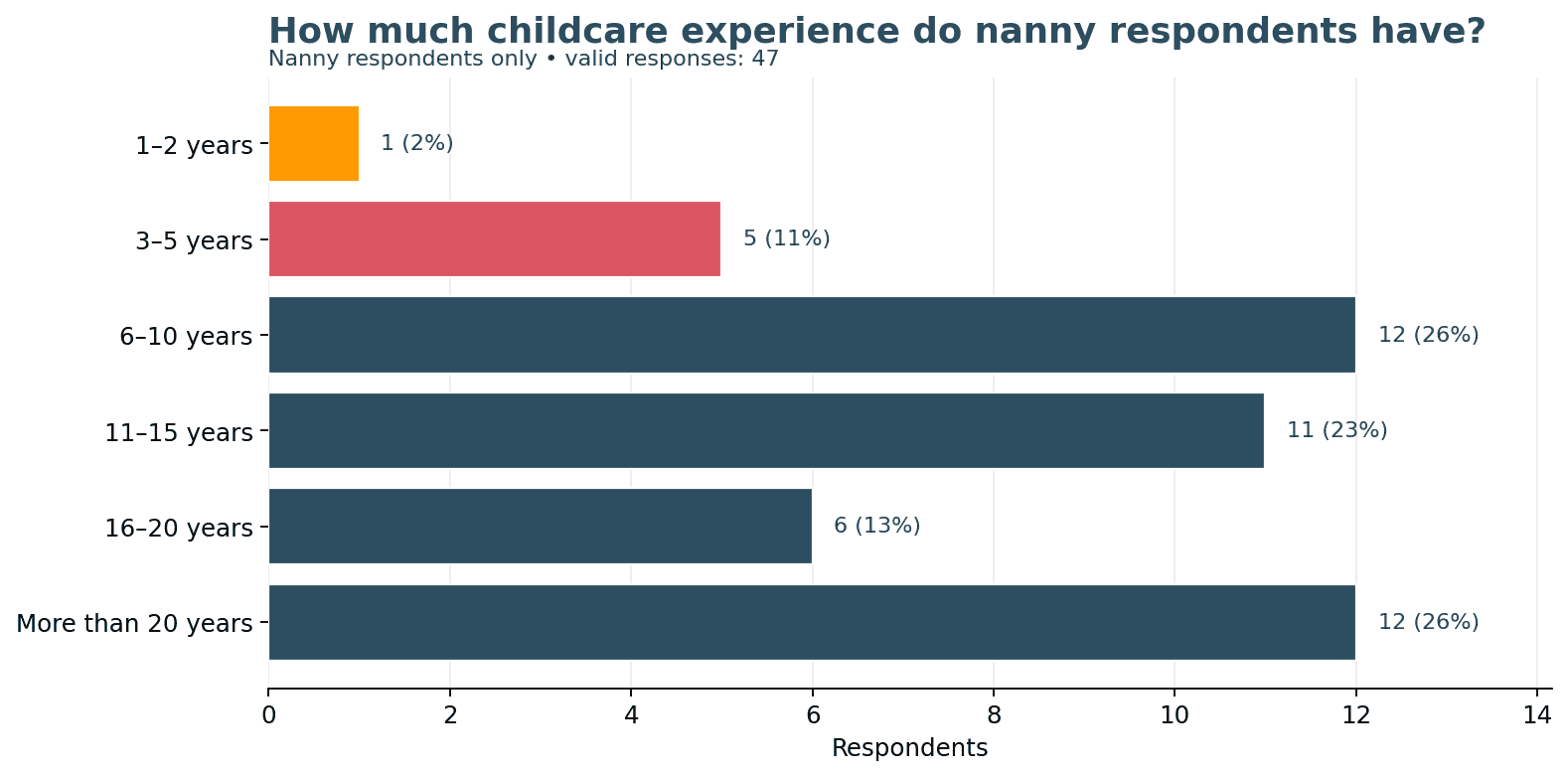
Most of the nannies who participated in the 2026 US Nanny Institute Survey were experienced childcare professionals. Of the 47 nanny respondents, 41 reported at least six years of paid in-home childcare experience.
Experience was distributed across established career stages. Twelve respondents had 6 to 10 years of experience, 11 had 11 to 15 years, 6 had 16 to 20 years, and 12 had more than 20 years.
Only 6 of the 47 nanny respondents reported fewer than six years of paid in-home childcare experience.

What does this tell us about nanny professional development?
The survey primarily reflects experienced working nannies rather than people entering childcare for the first time. This is important when interpreting the education findings that follow. Interest in training and professional development extends well into an established nanny career, including education that adds specialization, strengthens professional knowledge and supports continued career development.
What qualifications do nanny respondents currently hold?
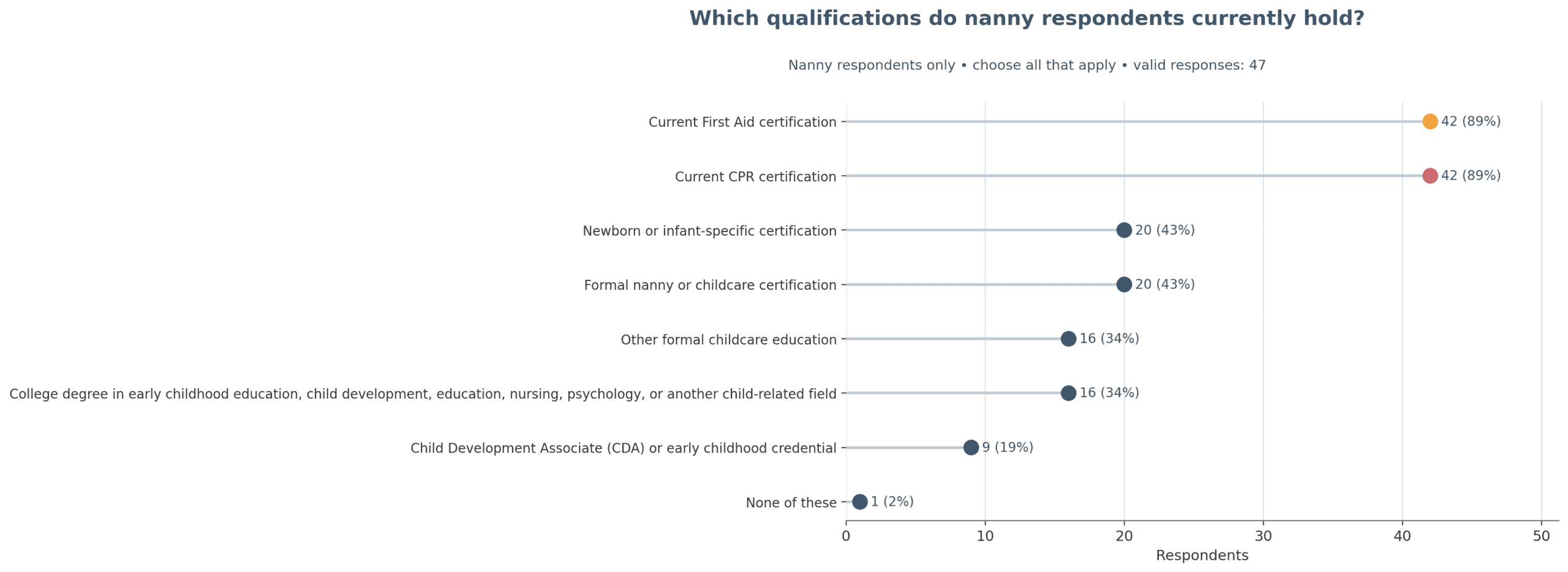
CPR and First Aid were the most common qualifications reported by nanny respondents. Formal nanny, childcare and newborn-specific certifications were also held by a substantial portion of the experienced nannies who participated.
Twenty of the 47 nanny respondents, or 43%, reported a formal nanny or childcare certification. The same number reported a newborn or infant-specific certification.
Sixteen respondents, or 34%, held a college degree in a child-related field, while 9 respondents, or 19%, reported a Child Development Associate or other early childhood credential.

What does this tell us about professional nanny qualifications?
Safety credentials were common among the nannies surveyed, while formal nanny, childcare and newborn-specific certifications were less universal. The results show a distinction between baseline safety preparation such as CPR and First Aid and additional education or credentials that document broader or more specialized childcare knowledge.
Experienced career nannies who want comprehensive childcare education can explore the Professional Nanny training and certification program.
How much formal nanny or childcare education have respondents completed?
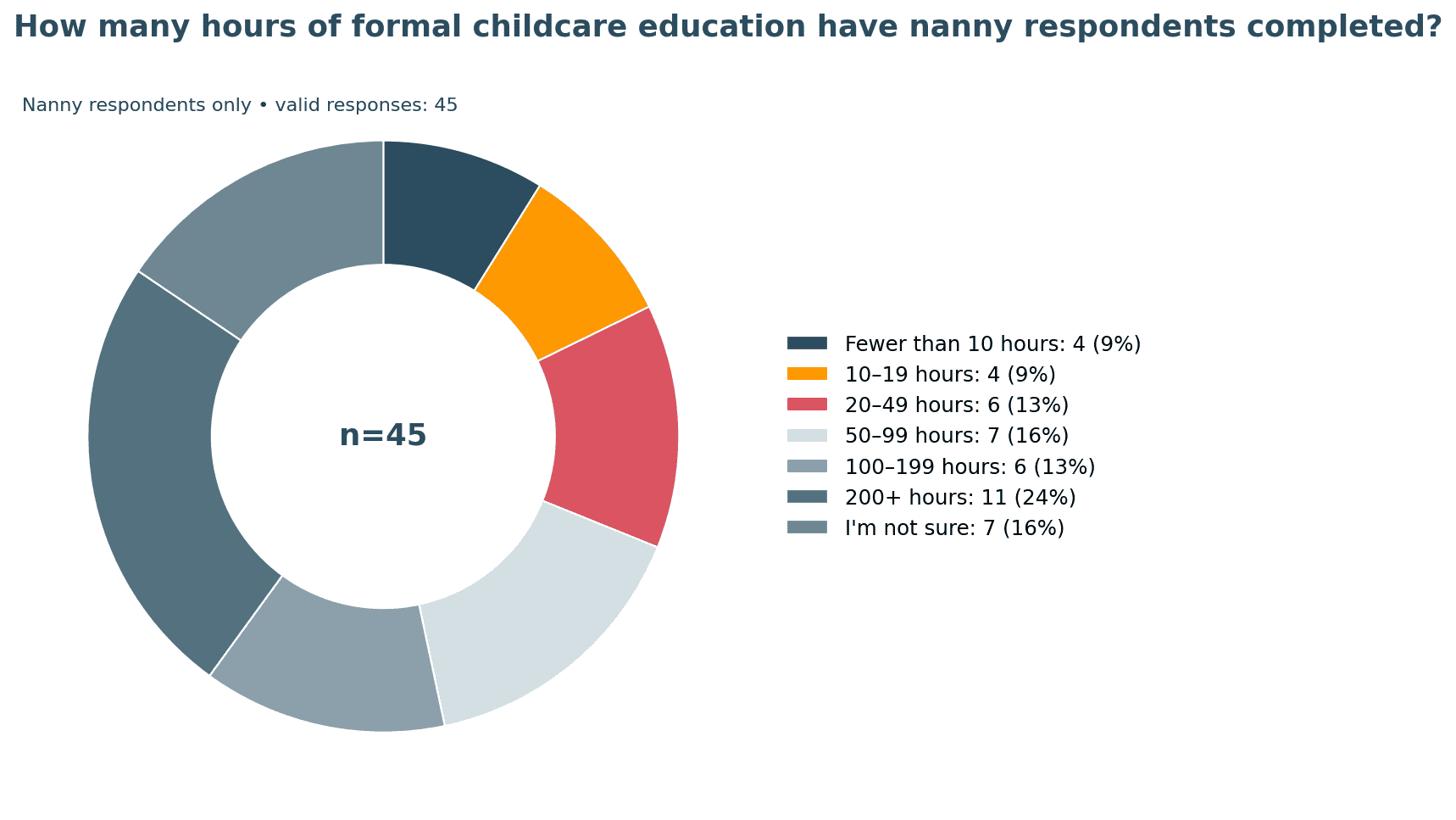
Many nanny respondents reported completing substantial formal childcare education in addition to CPR and First Aid. Among the 45 nannies who answered this question, more than half had completed at least 50 hours of formal nanny or childcare education.
Twenty-four of the 45 respondents reported at least 50 hours of formal education. This included 7 with 50 to 99 hours, 6 with 100 to 199 hours, and 11 with 200 or more hours.
Eight respondents reported fewer than 20 hours, 6 reported 20 to 49 hours, and 7 were unsure how many hours of formal childcare education they had completed.

What does this tell us about continuing nanny education?
The results suggest that professional education can continue well beyond initial nanny preparation. A substantial portion of these experienced caregivers had accumulated 50, 100 or even 200 or more hours of formal childcare education, supporting the idea that nanny education can develop progressively throughout a career as caregivers deepen their knowledge and add specialized skills.
Nannies who want to add documented childcare education to their professional qualifications can compare all six Nanny Institute certification programs. Nannies specializing in babies can also explore the Newborn and Infant Care Certification.
Who paid for nanny respondents' most recent formal childcare training?
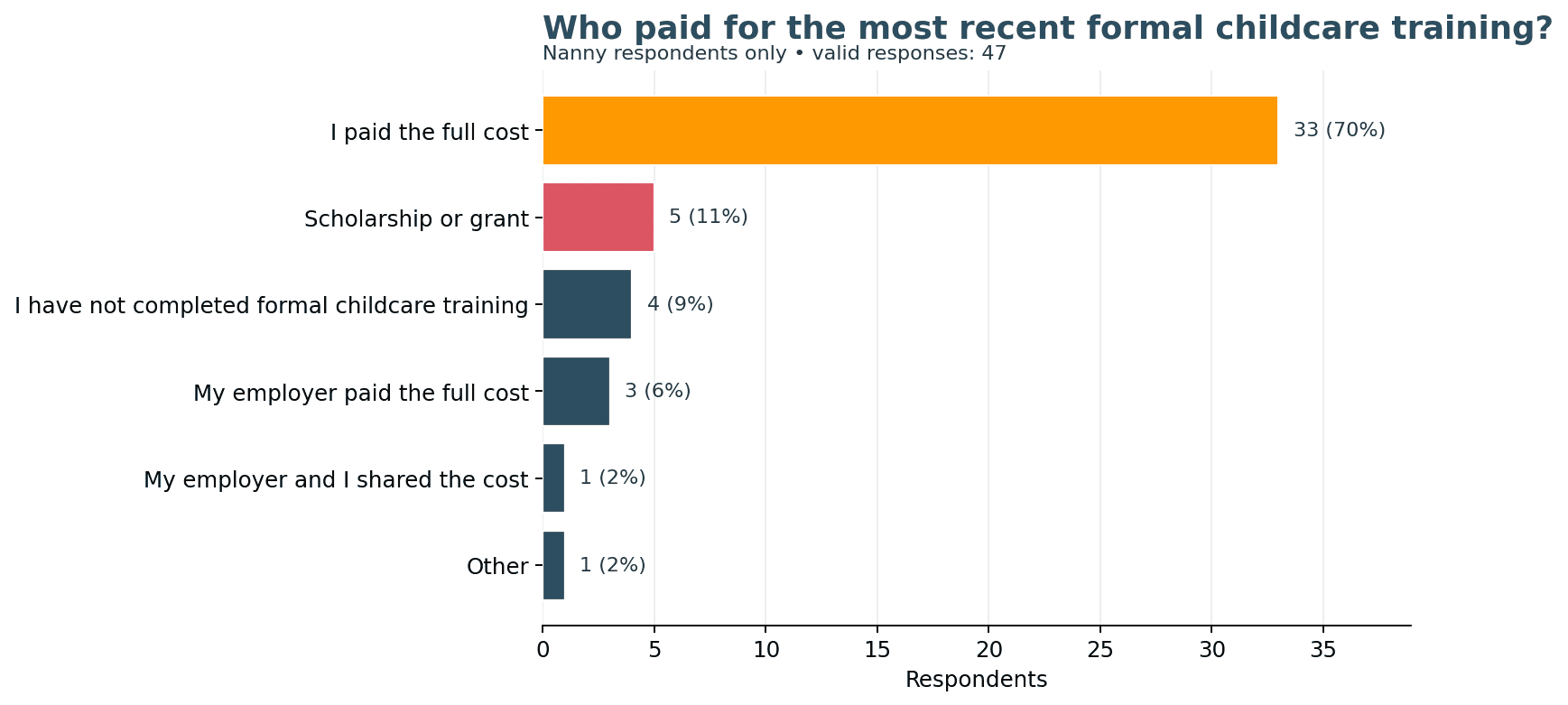
Most nanny respondents said they paid for their most recent formal childcare training themselves. Employer-funded training was much less common among the nannies who participated.
Thirty-three of the 47 nanny respondents said they paid the full cost. Five received a scholarship or grant, while 3 said their employer paid the full cost and 1 shared the cost with an employer.
Four respondents said they had not completed formal childcare training, and 1 selected another payment arrangement.

What does this tell us about paying for nanny professional development?
In this survey, professional development was largely financed by nannies themselves. That suggests experienced caregivers may view childcare education as an investment in their own careers, while also highlighting an opportunity for families to support training when additional knowledge or skills would benefit the children in their care.
For nannies seeking a comprehensive education pathway, the Professional Nanny program includes 50 hours of childcare training across the Institute's Basic, Intermediate, Advanced, Specialist and Professional levels.
Have family employers offered to pay for nanny training?
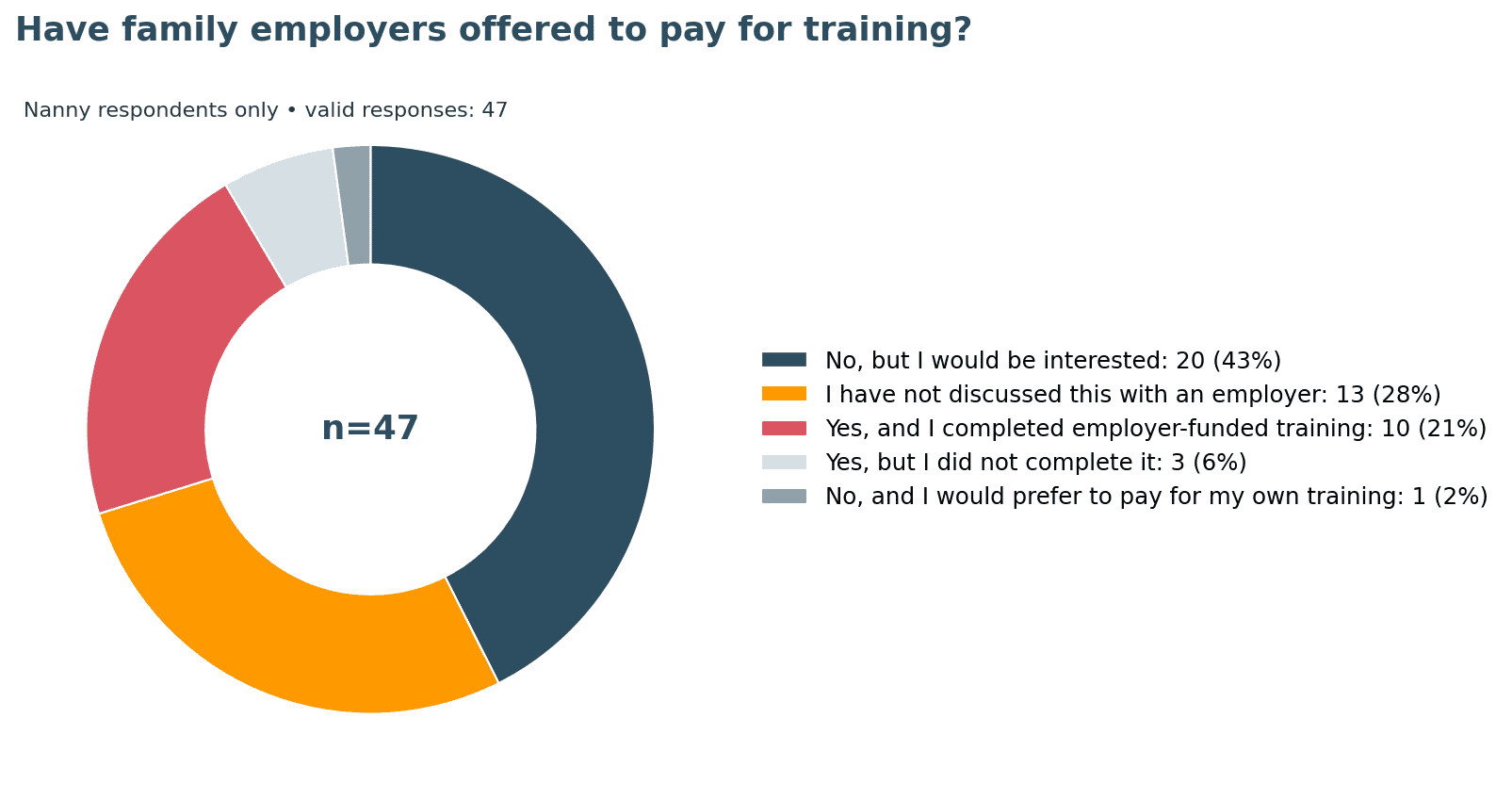
Employer support for professional development was mixed. Some nanny respondents had completed employer-funded training, while many others had either never discussed training support with an employer or said they would be interested if it were offered.
Twenty of the 47 nanny respondents selected this response. Another 13, or 28%, said they had not discussed professional development or childcare training with an employer.
Ten respondents, or 21%, had completed employer-funded training. Three said an employer had offered to pay but they did not complete the training, while 1 respondent preferred to pay for training independently.

What does this tell us about employer-supported nanny training?
The results suggest there may be more interest in employer-supported professional development than current participation indicates. Nearly half of nanny respondents said they would be interested in employer-funded training, and another group had never discussed the subject with an employer. Families that value additional childcare knowledge may have an opportunity to make professional development part of the employment conversation.
Nannies can compare Nanny Institute programs, training hours and tuition before choosing a program. Families that want to support a caregiver's professional development can also learn how to pay for their nanny's training.
What has helped nanny respondents obtain interviews, job offers or stronger employment opportunities?
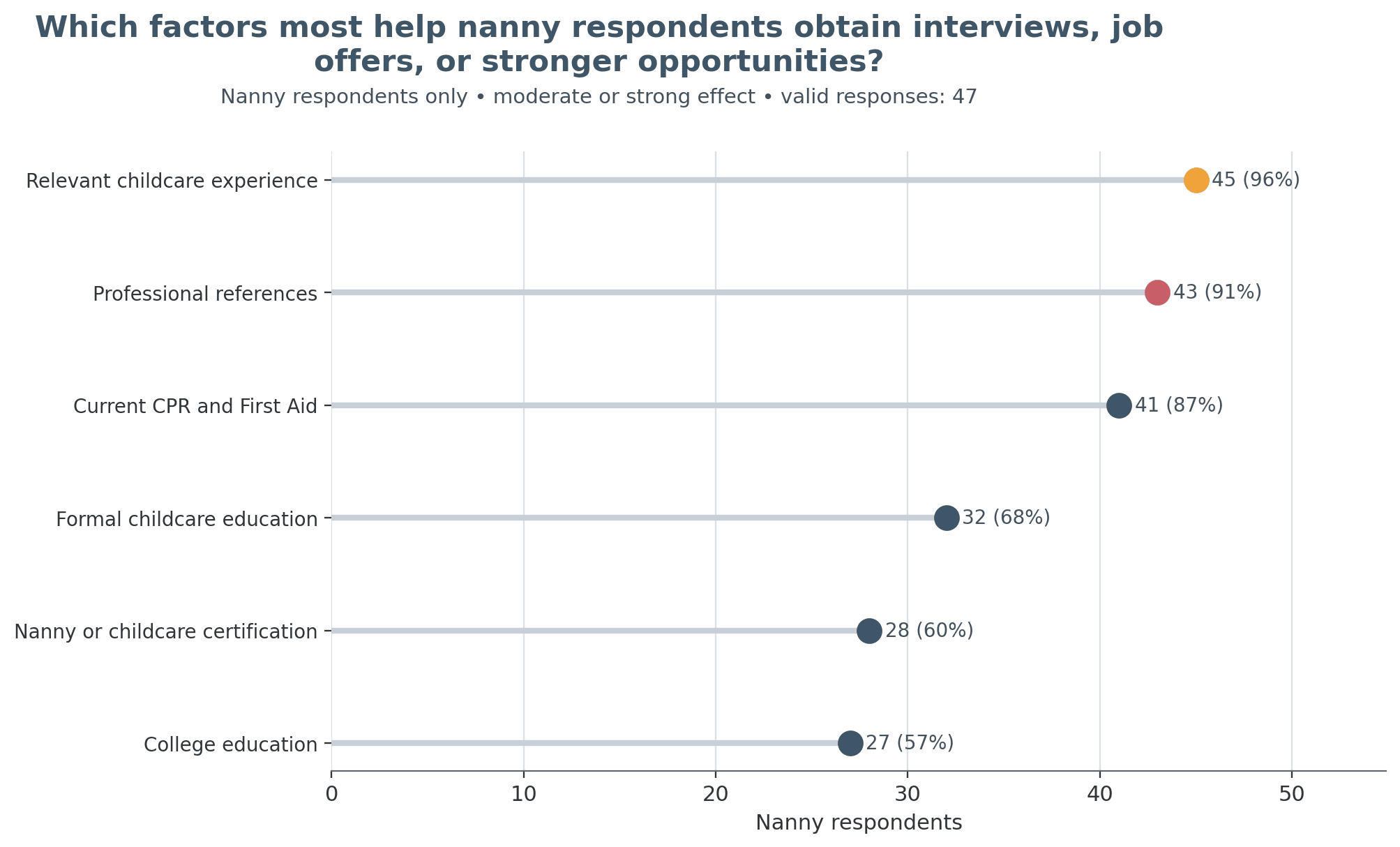
Experience and professional references were the strongest career factors reported by nanny respondents, but formal childcare education and certification were also viewed as helpful by a majority of participants.
Relevant childcare experience received the strongest response, with 45 of 47 nannies, or 96%, reporting a moderate or strong effect. Professional references followed at 91%, and current CPR and First Aid at 87%.
Formal childcare education was rated as having a moderate or strong effect by 32 respondents, while 28 said the same about nanny or childcare certification and 27 about college education.

What does this tell us about the value of nanny education?
Experience and references remain central to a nanny's professional record, but the survey suggests that education can strengthen that record rather than replace it. More than two-thirds of nanny respondents associated formal childcare education with stronger employment opportunities, indicating that structured learning can be one part of building a competitive professional profile alongside experience, safety credentials and strong references.
Families interested in supporting a nanny's professional development can pay directly for Nanny Institute training and choose a program that fits their caregiver's responsibilities.
What additional childcare education would be most valuable to nanny respondents?
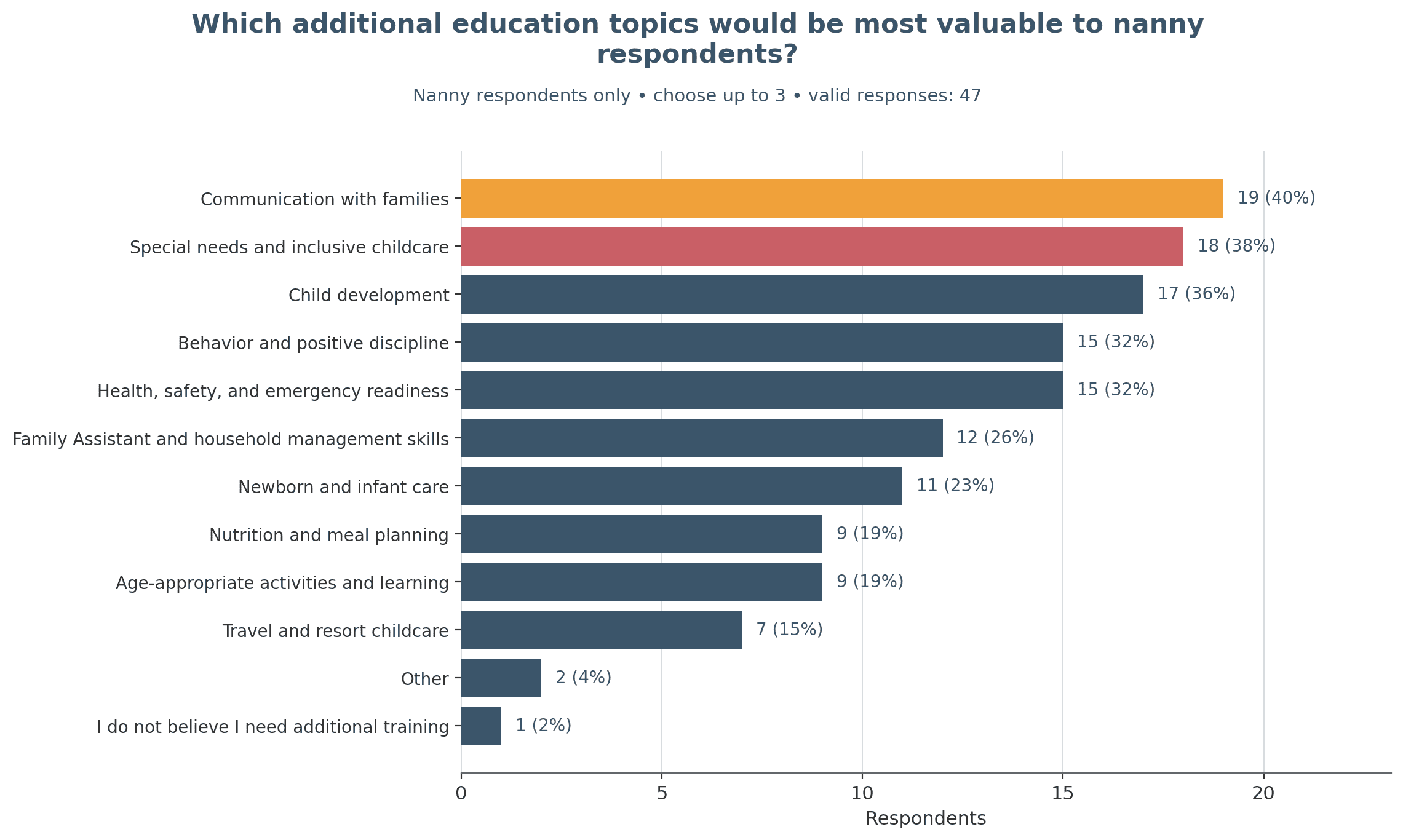
Nanny respondents showed interest in both child-focused education and skills that support stronger working relationships with families. Communication with families was the most-selected topic, followed closely by special needs and inclusive childcare and child development.
Special needs and inclusive childcare was selected by 18 of 47 respondents, or 38%, followed by child development at 36%.
Behavior and positive discipline and health, safety and emergency readiness were each selected by 32%. Other interests included Family Assistant skills, newborn and infant care, age-appropriate activities, nutrition and travel childcare.

What does this tell us about continuing education for professional nannies?
Professional development needs extend beyond childcare techniques alone. Respondents also valued communication, inclusion and family relationship skills, suggesting that continuing nanny education can support both the care of children and the professional skills needed to work effectively within a household.
Nannies who want to add structured childcare education to their professional profile can compare nanny training and certification programs, including the Institute's comprehensive Professional Nanny program.
What makes a nanny training program credible?
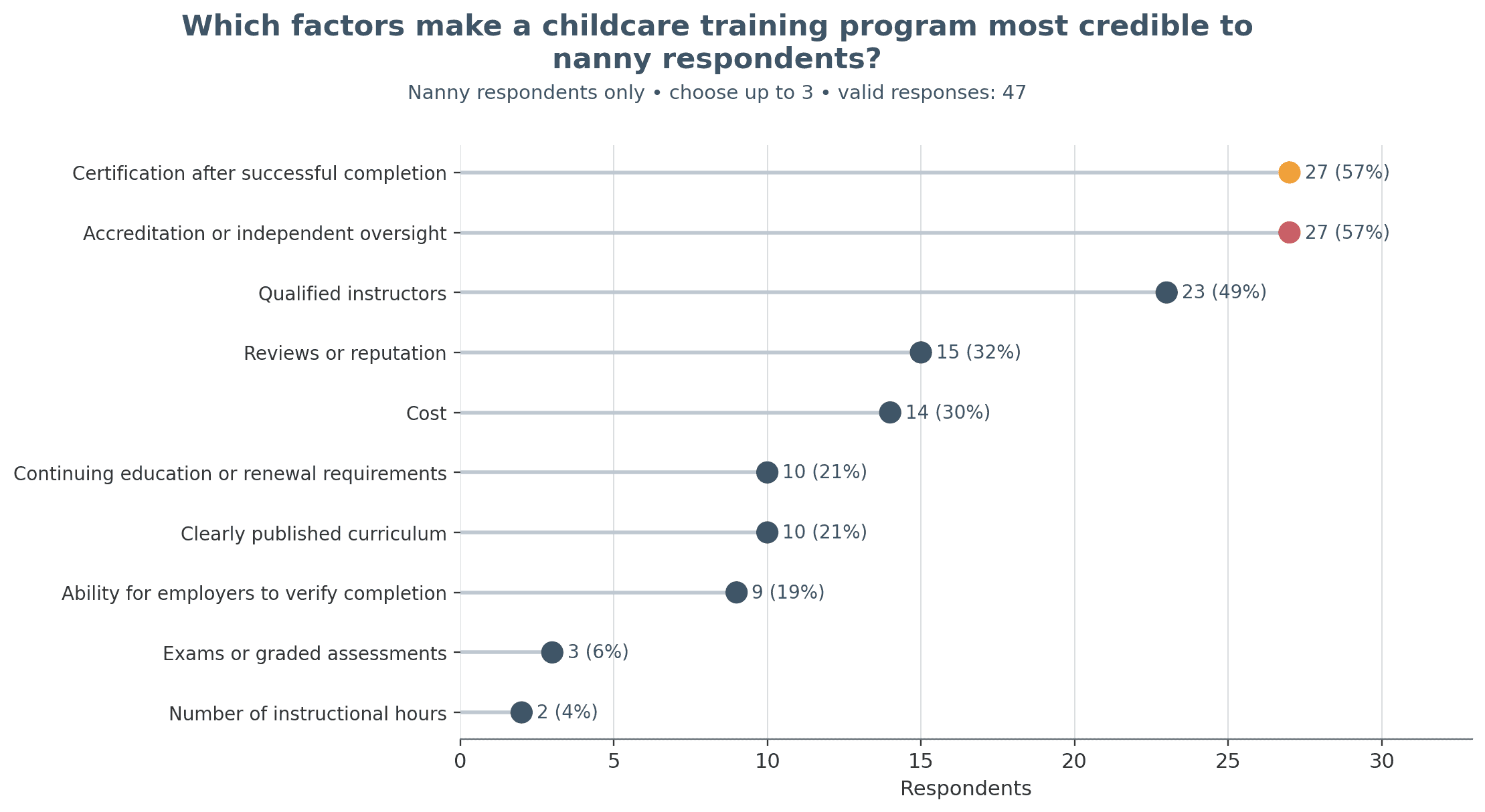
Nanny respondents placed the greatest value on external oversight, successful completion and instructor qualifications when judging the credibility of a childcare training program.
Certification after successful completion was also selected by 27 of 47 respondents, or 57%. Qualified instructors followed at 49%.
Reviews or reputation, cost, a clearly published curriculum and continuing education requirements were also considered important, while course length and graded assessments were selected less often.

What does this tell us about choosing credible nanny training?
Respondents looked beyond price or the number of training hours when judging credibility. Independent oversight, documented completion and qualified instructors ranked higher, suggesting that nannies value evidence that a program has structure, accountability and knowledgeable educators behind it.
These interests are addressed across Nanny Institute programs. The Advanced Nanny program includes communication, self-regulation and enrichment topics; the Specialist Nanny program includes children with disabilities, diversity and inclusion, special diets and household management; the Intermediate Nanny program focuses on age-appropriate care and development; and the Newborn and Infant Care program provides specialized education for caregivers working with babies and infants.
Which online learning features do nanny respondents value most?
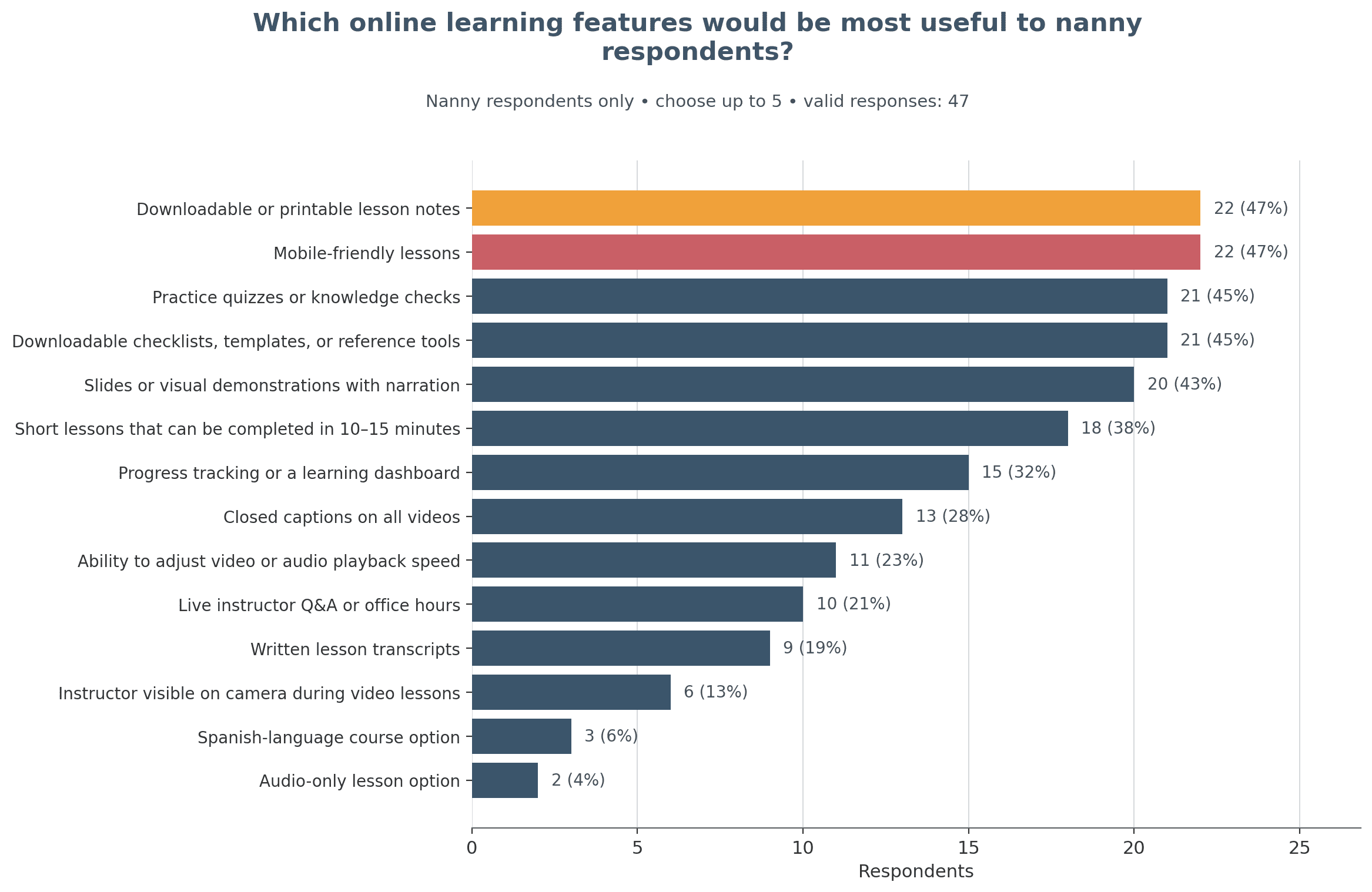
Nanny respondents favored practical features that make online education easier to use, review and apply. Downloadable lesson notes and mobile-friendly access were selected most often, followed closely by checklists, templates and practice quizzes.
Checklists and templates and practice quizzes were each selected by 21 of 47 respondents, or 45%. Slides or visual demonstrations followed at 43%.
Short 10 to 15 minute lessons were selected by 38%, while respondents also valued progress tracking, captions, adjustable playback speed, live Q&A and transcripts.

What does this tell us about online nanny education?
Respondents placed substantial value on flexibility and practical learning tools. Features that allow nannies to study from different devices, review material later and test their understanding ranked highly, suggesting that effective online professional development should make learning convenient as well as useful.
Prospective students can evaluate these factors directly by reviewing the US Nanny Institute's accreditation information, college faculty and full nanny training curriculum.
What nanny training do agencies value most?
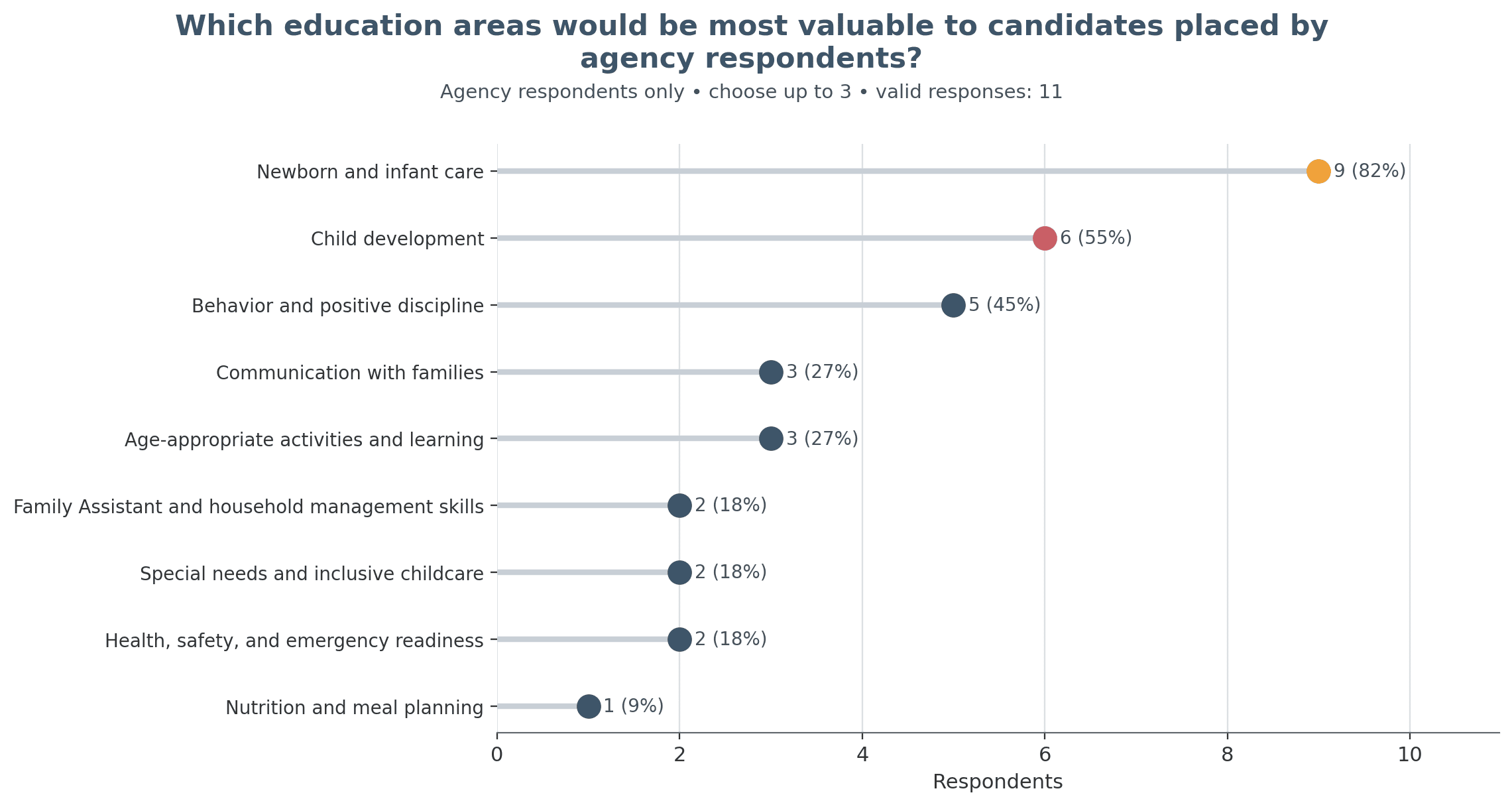
Newborn and infant care stood out as the education area most valued by the nanny agencies that participated in the survey. Agencies also placed importance on child development, behavior and positive discipline, and age-appropriate activities.
Child development was selected by 6 of the 11 agency respondents, while 5 selected behavior and positive discipline.
Agencies also selected age-appropriate activities, communication with families, Family Assistant skills, health and safety, special needs and inclusive childcare, and nutrition.

What does this tell us about specialized nanny education?
Among the agencies surveyed, newborn and infant care was the clearest education priority for nanny candidates. The results suggest that specialized training may be particularly valuable when a nanny is pursuing positions involving infants, while broader education in child development, behavior and family communication can also strengthen professional preparation.
Nannies who want to build specialized knowledge for infant-focused positions can explore the 20-hour Newborn and Infant Care training and certification program.
Agency findings are based on 11 respondents and should be interpreted as directional rather than representative of all nanny agencies.
How does education influence nanny placement?
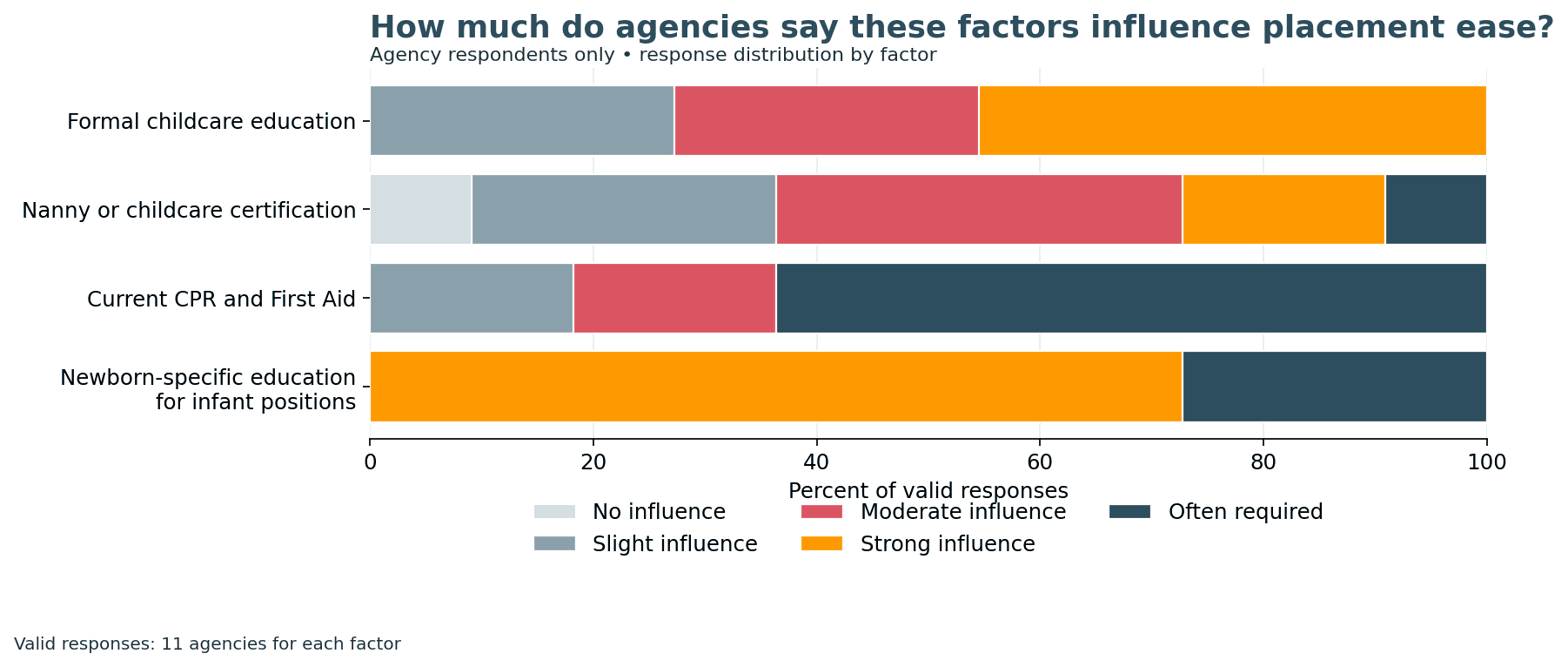
Education influenced how agency respondents viewed nanny candidates, with the strongest response appearing for newborn and infant positions. Formal childcare education, certification and CPR and First Aid also affected how agencies assessed candidates for placement.
Eight agencies said newborn-specific education had a strong influence on placement for infant positions, while 3 said it was often required.
All 11 agency respondents also said formal childcare education had at least some influence on placement. CPR and First Aid were often required by 7 agencies, while nanny or childcare certification had at least some influence for 10 of the 11 respondents.

What does this tell us about education and nanny placement?
The agency responses suggest that education can strengthen a nanny's professional profile, particularly when the education is relevant to the position. Newborn and infant education stood out most clearly for infant placements, while broader childcare education, safety credentials and certification also contributed to how agencies evaluated candidates.
Nannies pursuing infant-focused positions can explore the Newborn and Infant Care Certification. Nannies seeking broader professional childcare education can compare all six Nanny Institute programs.
Agency findings are based on 11 respondents and should be interpreted as directional rather than representative of all nanny agencies.
What makes nanny training credible to agencies?
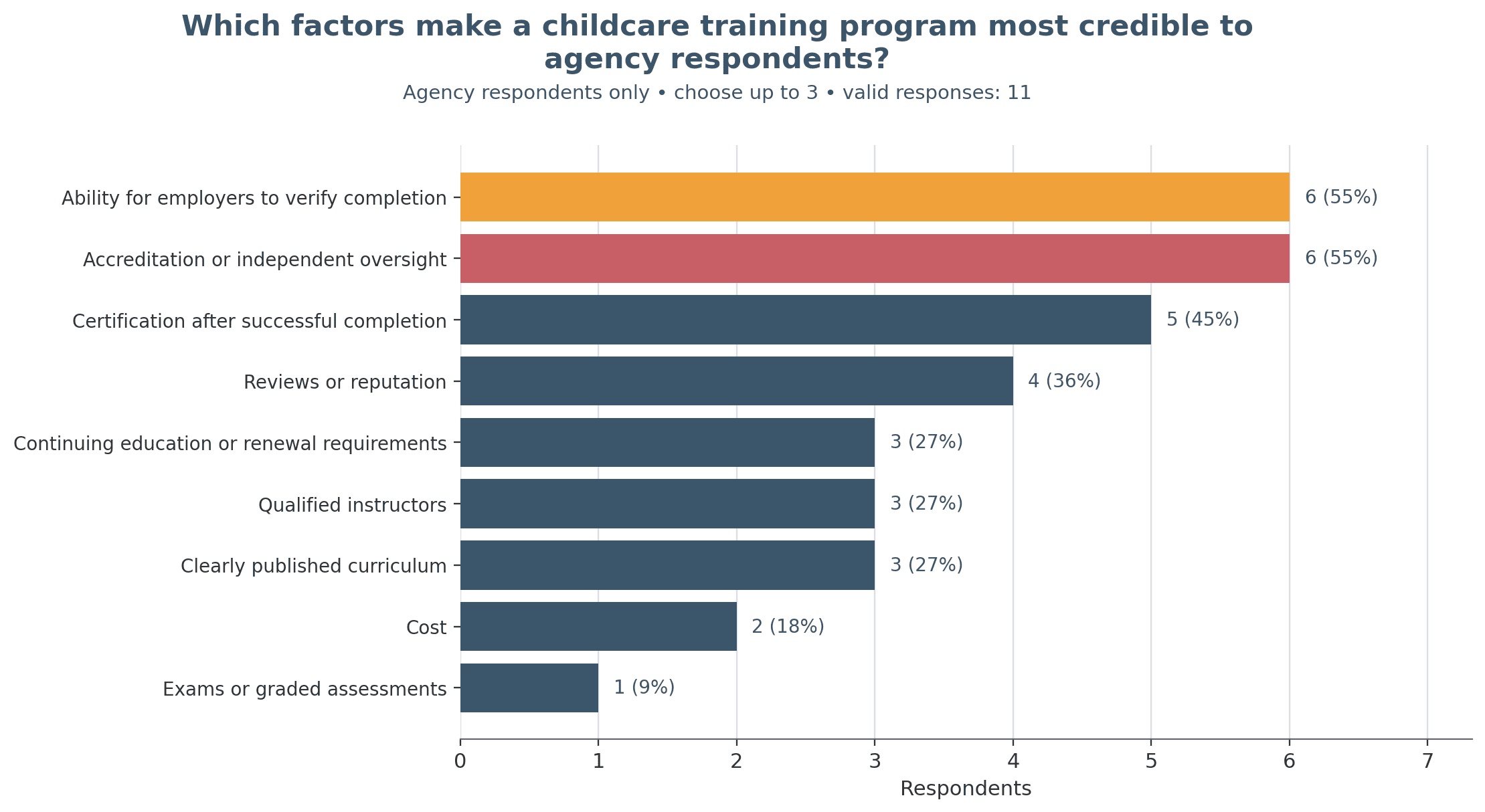
Agency respondents placed the greatest value on employer verification and accreditation or independent oversight when evaluating the credibility of a nanny training program. Certification after successful completion also ranked highly.
Employer verification was also selected by 6 of the 11 agency respondents. Five selected certification after successful completion, while 4 selected reviews or reputation.
Published curriculum, continuing education or renewal requirements, and qualified instructors were each selected by 3 agencies.

What does this tell us about agency expectations for nanny training?
Agency respondents appeared to value training that can be independently verified and supported by clear quality controls. Accreditation, employer verification and documented successful completion all ranked above course length or price, reinforcing the importance of credibility and verifiability when professional education is used as part of a nanny's qualifications.
The Nanny Institute makes these quality indicators available for review, including information about its NCFE CACHE accreditation, faculty and instructors, and published childcare curriculum.
Agency findings are based on 11 respondents and should be interpreted as directional rather than representative of all nanny agencies.
Who should pay for nanny training?
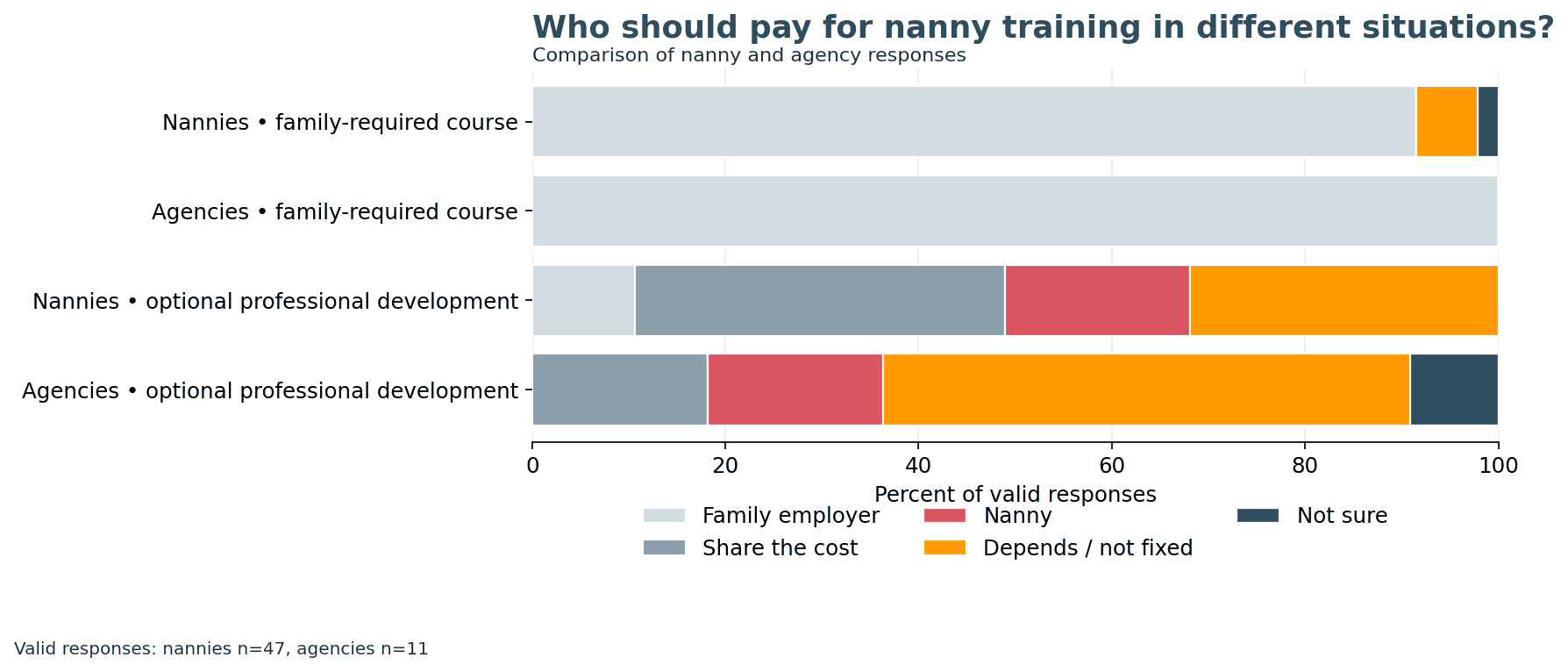
Survey respondents drew a clear distinction between training required for a specific nanny job and optional professional development. When a family requires a particular course, nannies and agencies overwhelmingly said the family employer should pay.
Forty-three of the 47 nanny respondents selected the family employer for required training. All 11 agency respondents agreed that the family should pay when a course is required for the position.
Views were more varied when training was optional. Among nannies, 38% favored sharing the cost and 32% said it depends on the situation. Among agencies, 6 of 11 said responsibility for optional training depends on the circumstances.

What does this tell us about paying for nanny professional development?
Respondents made the strongest distinction around who initiates the training. When a family requires education for a particular job, there was broad agreement that the employer should cover the cost. Optional professional development was viewed more as a shared or situation-dependent responsibility because some education benefits a nanny's broader career while other training directly supports the needs of a specific household.
Families that want to provide or require professional childcare education can learn how to pay for their nanny's training directly through the US Nanny Institute.
No family employers participated in the survey, so these findings reflect the views of nanny and agency respondents rather than the views of families themselves.
  | Want to receive additional information? We'll share nanny hiring tips, contract examples and industry survey results. |
Frequently asked questions
What is the 2026 US Nanny Institute Survey?
The 2026 US Nanny Institute Survey gathered information from nannies and nanny agencies about professional experience, childcare education, training, qualifications and career development. This report focuses on education and professional development. Nannies interested in building their childcare knowledge can also compare the Institute’s six online nanny training and certification programs.
How many people participated in the survey?
The survey received 60 responses between September 16 and October 3, 2026. Participants included 47 nannies or in-home childcare providers, 11 nanny agency or placement professionals, and 2 respondents who selected another role.
Is the 2026 Nanny Survey nationally representative?
No. The survey used a self-selected convenience sample. The findings describe the people who participated and should not be interpreted as national estimates for all nannies, nanny agencies or family employers.
Did family employers participate in the survey?
No family employers participated. Findings about employer-funded education or who should pay for training reflect the views of nanny and agency respondents and should not be interpreted as evidence of family-employer attitudes or behavior. Families interested in professional development for a caregiver can learn how to pay for a nanny’s training directly through the Institute.
What additional training did nanny respondents want most?
Communication with families was the most-selected area of additional education, followed by special needs and inclusive childcare and child development. These subjects are addressed across the Institute’s Advanced Nanny, Specialist Nanny and Intermediate Nanny programs. Nannies focused specifically on babies can also explore the Newborn and Infant Care program.
What makes a nanny training program credible?
Among nanny respondents, accreditation or independent oversight and certification after successful completion were the most frequently selected credibility factors. Qualified instructors also ranked highly. Prospective students can review the US Nanny Institute’s accreditation, faculty and full course curriculum when evaluating its training programs.
Does formal childcare education help nannies get jobs?
Thirty-two of 47 nanny respondents, or 68%, said formal childcare education had a moderate or strong effect on obtaining interviews, job offers or stronger opportunities. Experience, professional references and CPR and First Aid were rated even more highly, so education should be considered one part of a broader professional profile rather than a guarantee of employment. Nannies interested in adding structured education to their professional profile can compare Nanny Institute training programs from Basic through Professional.
What education did nanny agencies value most?
Nine of the 11 agency respondents selected newborn and infant care as one of the three most valuable areas of education for nanny candidates. Child development and behavior and positive discipline were also frequently selected. Because only 11 agencies participated, these findings should be interpreted cautiously. Nannies interested in infant-focused positions can explore the Institute’s 20-hour Newborn and Infant Care Certification.
Who should pay when a family requires a nanny to complete specific training?
Forty-three of 47 nanny respondents, or 91%, said the family employer should pay when a particular course is required for the job. All 11 agency respondents agreed. Opinions were more varied when professional development was optional rather than required for a specific position. Families can learn how to pay for Nanny Institute training for their nanny.
Can the 2026 US Nanny Institute Survey findings be cited?
Yes. Cite the US Nanny Institute and the 2026 Nanny Survey and include the relevant respondent group or sample size when it is important to understanding the finding. The results should not be described as national statistics or industry-wide benchmarks.
Which Nanny Institute training program should I choose?
The right program depends on your experience and career goals. Basic Nanny introduces foundational childcare safety and professionalism. Intermediate Nanny adds age-specific care from newborn through the elementary years. Advanced Nanny adds communication, self-regulation and enrichment. Specialist Nanny includes special needs, inclusive care and household management. Professional Nanny is the Institute’s most comprehensive career-nanny program. Nannies who work specifically with babies can choose the stand-alone Newborn and Infant Care Certification. You can also compare all six nanny certification programs.
Turn professional development into your next career step
The US Nanny Institute offers six online nanny training and certification programs for childcare professionals at different stages of their careers, from foundational training through Professional Nanny and specialized Newborn and Infant Care.
Compare all nanny training programs or review enrollment options and tuition.